
🐾 My definition of ‘not possible’ is under review
Join me in this conversation with my late cocker spaniel, who still has questions - and opinions.
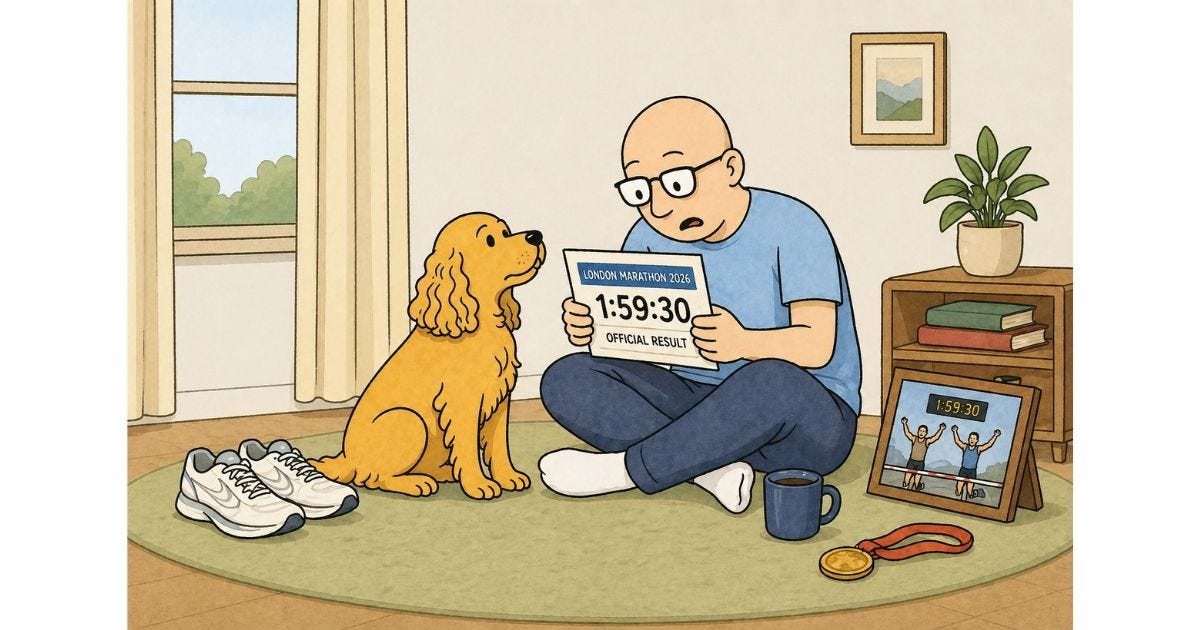
What a day for long-distance running.
At the London Marathon 2026, the two-hour barrier did not just fall — it was crossed twice in the same race.
Sabastian Sawe went under first.
Yomif Kejelcha followed, in his debut marathon.
One barrier. Two people. Same day.
Me: I saw the results.
Cookie: Impressive?
Me: Slightly inconvenient.
Cookie: For whom?
Me: For all the things I have quietly labeled “not possible.”
Cookie: That escalated quickly.
Me: I have a habit.
Cookie: Go on.
Me: If something feels difficult enough, I upgrade it.
Cookie: To?
Me: “Not for me.”
Cookie: Efficient.
Me: Very.
Cookie: Evidence-based?
Me: Not always.
Cookie: What kind of things?
Me: Small ones.
Cookie: Like?
Me: Skills I did not learn. Habits I did not stick to. Things I tried once.
Cookie: And retired.
Me: Respectfully.
Cookie: So what is the problem?
Me: Days like this.
Cookie: Because?
Me: Someone runs 42.2 kilometers in under two hours.
Cookie: Twice.
Me: Yes, that detail is unhelpful.
Cookie: Why?
Me: It makes my internal labels look… casual.
Cookie: Casual?
Me: Lightly assigned. Poorly tested.
Cookie: That is uncomfortable.
Me: Mildly.
Cookie: You are not planning to run a marathon.
Me: I have said that before.
Cookie: And?
Me: I have also signed up anyway.
Cookie: That weakens your argument.
Me: It weakens my confidence in my own labels.
Cookie: Fair.
Cookie: So what will you do?
Me: Nothing dramatic.
Cookie: Of course.
Me: Just audit a few labels.
Cookie: Remove some?
Me: Maybe downgrade them.
Cookie: To?
Me: “Not yet” sounds less permanent.
Cookie: And more honest?
Me: Slightly more.
Cookie: That is progress.
Me: Quiet, but acceptable.
🐾 Barking Truth: “Impossible” is often just a convenient label for things you have not stayed with long enough.
A simple shift
Notice where you say “not possible.” That label deserves a second look.
Downgrade absolutes. “Not yet” leaves room to move.
Test lightly. You do not need full commitment to challenge an assumption.
Stay a little longer than usual. That is often where labels start to break.
If these Conversations with Cookie resonate, you might want to stay for the next one—and share it with someone who might need to hear it.