
The Last Squeeze
A bathroom mirror, a battered tube, and the satisfaction of using something all the way up.

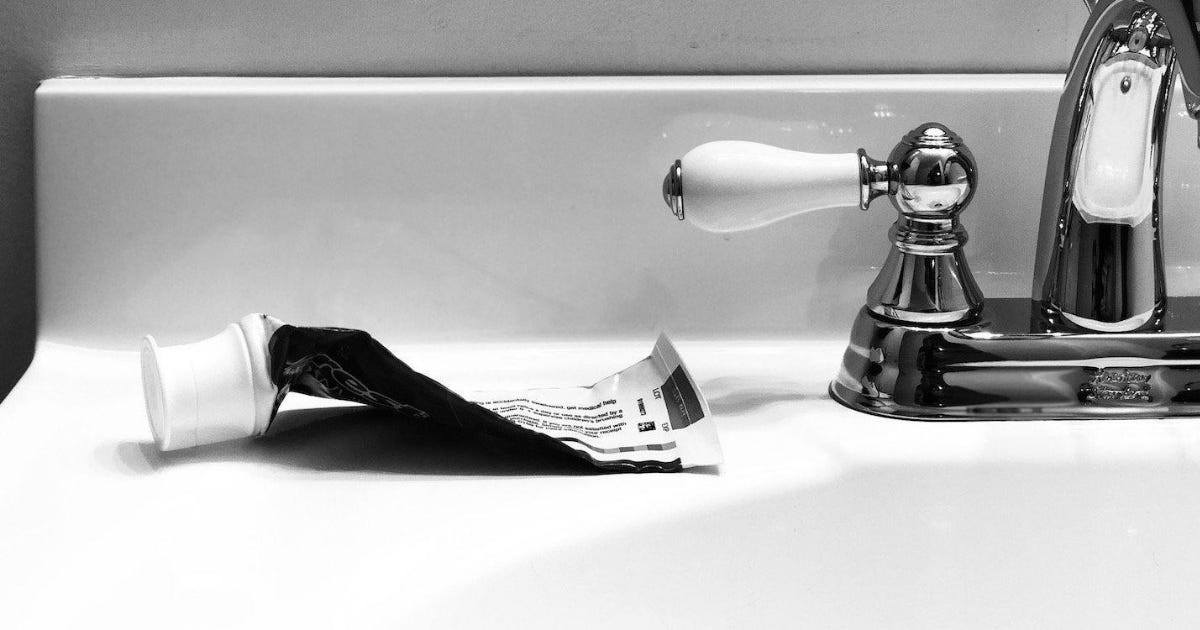
This morning I stood in front of the bathroom mirror doing something no reasonable person would bother with.
The toothpaste tube had clearly reached the end of its useful life. At least, that was what any reasonable person would have concluded. It had lost its original shape weeks ago. It had been squeezed from every conceivable angle, rolled up from the bottom, flattened against the edge of the sink and subjected to enough pressure to qualify as assault. But here I was, turning it over in my hands with the quiet confidence that there was still another day’s worth hiding somewhere inside.
Sure enough, after one more determined squeeze, out came a perfectly respectable ribbon of toothpaste.
I smiled, almost involuntarily.
Not because I had saved any meaningful amount of money. The toothpaste probably cost less than the americano I would buy later this afternoon without giving it a second thought. Nor was I particularly proud of my ingenuity. It was simply deeply satisfying to know that the tube had finally been used for what it was intended. It had given everything it had to give.
That got me wondering - Why do some of us do this?
Why do perfectly rational adults spend several extra minutes trying to extract the last few grams of toothpaste, while others would have thrown the tube away days earlier without the slightest hint of guilt?
And once I started thinking about it, I realised that toothpaste is merely the opening act.
The same people who refuse to surrender on toothpaste balance shampoo bottles upside down overnight because gravity deserves one final opportunity to contribute. They add just enough water to the almost-empty hand wash dispenser to coax out another dozen washes.
They somehow persuade two wafer-thin bars of soap to become one entirely functional new bar, although neither bar seems particularly enthusiastic about the arrangement. Ketchup bottles get tapped with an optimism that probably deserves its own research grant. Even a tube of skin cream that appears completely empty somehow yields another week of faithful service once someone decides to cut it open.
The interesting thing is that this habit rarely has much to do with affordability.
Many of the people I know who do this are perfectly capable of replacing these products without a second thought. They will happily spend money on a nice meal, a good pair of shoes or a holiday they have been looking forward to. Yet the idea of discarding a shampoo bottle that still contains two tablespoons of shampoo seems almost premature.
I don’t think it is really about money.
Some of it comes from the homes we grew up in. I suspect many of us were never explicitly told not to waste things. At least, I do not remember long lectures about resource utilisation or household economics. Instead, it was simply the way things were done. Gift wrapping paper was folded carefully after birthdays because it could be used again. Glass jars found second careers storing everything from sugar to nails to spare screws. Plastic containers accumulated in kitchen cupboards with optimism about their future usefulness. Plastic bags did not complete their original purpose because they inevitably returned home folded into another plastic bag. Old shirts became cleaning cloths. Old towels became rags. Even old notebooks somehow acquired new lives as rough books.
No one called it sustainability.
No one spoke about carbon footprints.
It was simply considered slightly disrespectful to throw away something that still had useful life left in it.
Whether that instinct came from necessity or simply from habit probably varied from household to household, but the instinct itself seems remarkably durable. Long after circumstances change, the behaviour often remains.
Maybe this has less to do with thrift and more to do with completion.
Some people cannot leave a book unfinished, even if they have stopped enjoying it three chapters ago. Others sit through every second of the film credits, not because they know anyone who worked on the production, but because leaving before the end somehow feels incomplete.
The last squeeze of toothpaste belongs to that same family, I think.
It is not about the toothpaste. It is about finishing the job.
About this point, I could almost hear Cookie interrupting me.
Me: You have been watching me stare at this tube for five minutes.
Cookie: Are you brushing your teeth today, or conducting research?
Me: I am trying to understand why some of us do this.
Cookie: No. You are trying to justify why you do this.
He may well have been right.
After all, we humans have a wonderfully inconsistent relationship with value. I will scrape a peanut butter jar into submission and then leave half a bowl of food untouched because I happened to lose my appetite. We agonise over three drops of shampoo while abandoning hobbies after two weeks, subscriptions after one month and expensive gadgets after the novelty wears off.
Every one of us has a peculiar definition of what deserves to be fully used.
And that is perfectly fine. Not every habit has to survive a spreadsheet. Some habits simply make us feel that the world is ever so slightly more orderly than it was yesterday.
There is something satisfying about reaching the genuine end of something. About knowing that an object fulfilled the purpose for which it was made. That it was not discarded because it merely appeared empty, but because it finally was.
I have absolutely no evidence that people who squeeze toothpaste tubes are happier, wiser or more responsible than those who do not.
In fact, they might simply have more patience. Or more stubbornness. Or perhaps they simply enjoy the quiet satisfaction of extracting every last bit of usefulness from something before saying goodbye to it.
I also have no desire to convince anyone to join this particular tribe. If you replace your toothpaste tube halfway through its life, I promise I shall not lose any sleep over it.
But I do find myself wondering whether the people who extract every last drop from a toothpaste tube are also the ones who linger a little longer at the end of a holiday, or finish reading the acknowledgements at the back of a book. Some of us simply have an unusual relationship with endings. We like to know that we experienced something completely before moving on.
Or I am reading far too much into a rather battered tube of toothpaste.
Then again, the soap in my bathroom has reached the stage where most people would probably unwrap a new one.
I think it still has a little life left in it.
Ranga
I have smiled involuntarily from last several decades including shampoo bottle upside down
Enjoyed reading
You’ve unlocked a whole new dimension on this one 🤯🤩